
Third Places 101: Part 2 of 2

How communities are protecting, creating and maintaining their own third places.
Last week we explored what third places are, why they're crucial for community building and social connectedness, and why they're chronically undervalued despite this. This week, we're looking at some clever ways communities are protecting, creating, and maintaining their own third places.
Most of these are examples we've come across in our own work or personal lives that have resonated because of a community's sheer ingenuity in thinking laterally to solve a problem.
Green bans
Probably our favourite example of protecting a third place is the 1971 fight to save Kelly's Bush in Hunters Hill, Sydney. Thirteen local women, known as the "Battlers for Kelly's Bush," had spent months lobbying the council, the local MP and even the Premier to stop developer AV Jennings from building luxury housing on the last remaining stretch of open bushland in the area, all without success. As a last resort, they turned to the NSW Builders Labourers Federation, whose members voted to ban any work on the site after more than 600 locals showed up to a public meeting in support. It was the world's first green ban. The ban held for over a decade, and in 1983 the NSW Government bought the land outright, permanently protecting it as public open space.
While green bans were far more prevalent in the 1970s, a more recent example occurred in Melbourne in 2022, involving long-time Melbourne institution, the John Curtin Hotel. An overseas developer bought the hotel and planned to close it and turn it into luxury apartments. This time, the Building Industry Group (BIG), alongside a coalition of unions and cultural organisations, rallied together to save the hotel by putting a green ban on the site. It's now on the Victorian Heritage Register.
Crowdfunding
Crowdfunding lets communities raise funds beyond their immediate network, and it's what saved The Tote. A Pozible campaign raised over $3 million to save the Collingwood live music venue, which was facing closure after being put up for sale. The new owners have since placed The Tote into a legal trust, ensuring it remains a live music venue in perpetuity — never to be sold off again!
Co-op approaches
Sometimes saving a pub means buying it outright. When Aireys Pub on the Great Ocean Road faced closure, the community rallied around it, pooling resources to buy and now operate the pub themselves. Ten locals came together to become co-owners, keeping open a place that's been central to the town for generations.
Grants and traditional club fundraising
It's not just pubs worth saving either; here in Australia, we love our sporting clubs, whether football, tennis, surf lifesaving or otherwise. Traditional fundraising and targeted grants have kept our clubs alive for years.
One source is the Victorian Government's Tiny Towns Fund, which offers grants of up to $50,000 to help small regional communities upgrade facilities like clubrooms, courts and halls. Taylors Lake Football Netball Club, a small rural club 12km east of Horsham founded by local farming families after the Second World War, is exactly the kind of club the fund exists for.
And it's not just government grants keeping these places alive; there's a host of non-government grants available too. The Heart Foundation, for instance, offers small grants to support community health initiatives, including funding for local walking groups to grow and stay active. Others worth a mention: Bendigo Bank's Community Bank network and Foundation, which fund local clubs and groups directly through their branches; the Foundation for Rural & Regional Renewal (FRRR), offering grants of up to $50,000 for projects that strengthen social connection in rural and regional communities; and the ANZ Community Foundation, which provides grants of up to $30,000 to community organisations around the country.
Clever ways to cover operating costs
Keeping a third place open isn't just about the initial fight to save it — it's about finding ways to keep the lights on, year after year, without leaning entirely on ratepayers or government grants.
One approach is self-service hours. Libraries in Australia have been addressing limited resourcing by introducing self-service access. Yarra City Council, through its "Open Library" program, offers members at several branches an induction program that then lets them access the library outside staffed hours, from as early as 8am to as late as 10pm, including public holidays.
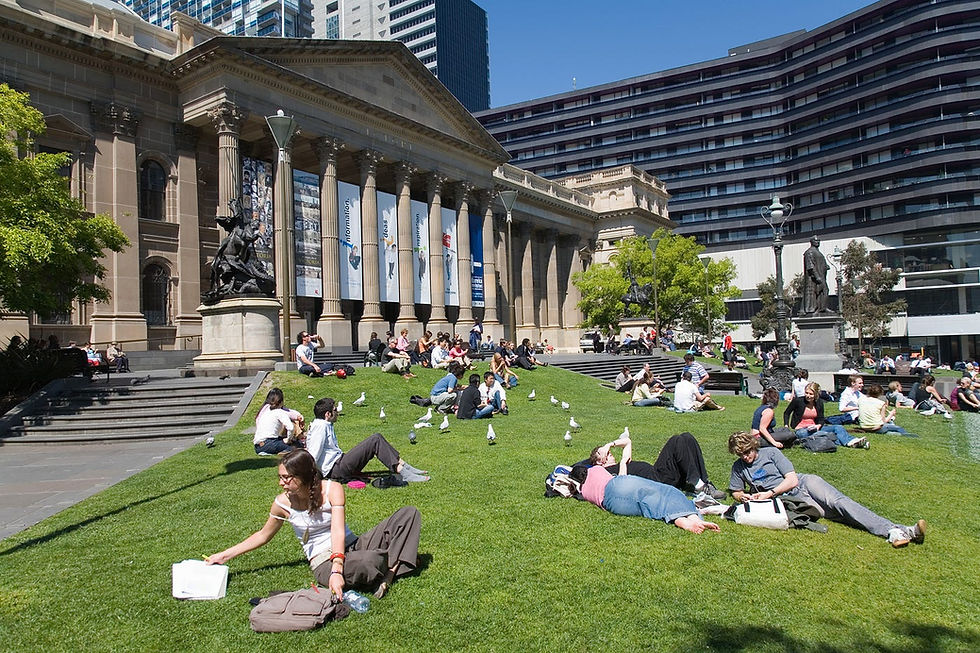
Another is commercial leasing. The State Library of Victoria has long leased out its café space to independent operators, generating rent income while the café itself becomes part of the building's character, staff have described it as "the heart of the library" in its own right. It's a reminder that a third place doesn't need to fund itself purely through its core purpose; a well-placed commercial tenant can help carry the costs of keeping the doors open to everyone else.
It's not just third places that get creative about this either. Rural CFA fire brigades (while obviously not third places themselves) often run a genuinely clever side hustle: inspecting and servicing fire extinguishers, blankets and hose reels for local businesses, which are legally required to have this done every six months. One Sunbury brigade services 300–400 local business customers, with that income going directly toward vehicles and equipment. It's the same principle as the library café, using a revenue-generating activity to subsidise the core mission.
Voluntary planning agreements
In NSW, Marrickville Library was delivered through a negotiated agreement between Inner West Council and developer Mirvac: in exchange for the right to build residential apartments on the site of the old Marrickville Hospital, Mirvac funded and constructed a new library, community hub, children's playground and public open space. Eventually handing the completed civic facilities over to the council as part of the deal.
Third places don't have to be formally programmed
Not every solution needs a union, a crowdfunding page or a planning agreement behind it. You don't need to join a formal group to get the same benefit; you can arrange a walk with a friend, hang out in the park, or contribute to a local greening project. Third places, at their heart, are as simple as showing up somewhere, regularly, with other people.
At Village Well, we know the importance of third places and how they foster flourishing cultures and communities. We work with communities to make places that work for you. Reach out to us for your next project.


Comments